Key points
- Much of Assam's tea is plucked by women, paid by the day and by output. Their communities were brought to the plantations from central and eastern India in the nineteenth century.
- Maternal mortality in Assam has been among the highest in India, and audits have found it higher still in Upper Assam, where most tea plantations are. Studies have found high levels of anaemia and high blood pressure in garden communities.
- USAID's Saksham project worked at several levels, from village health committees and tea garden hospitals to district forums, to help bring services closer to these women.
The land and the leaf
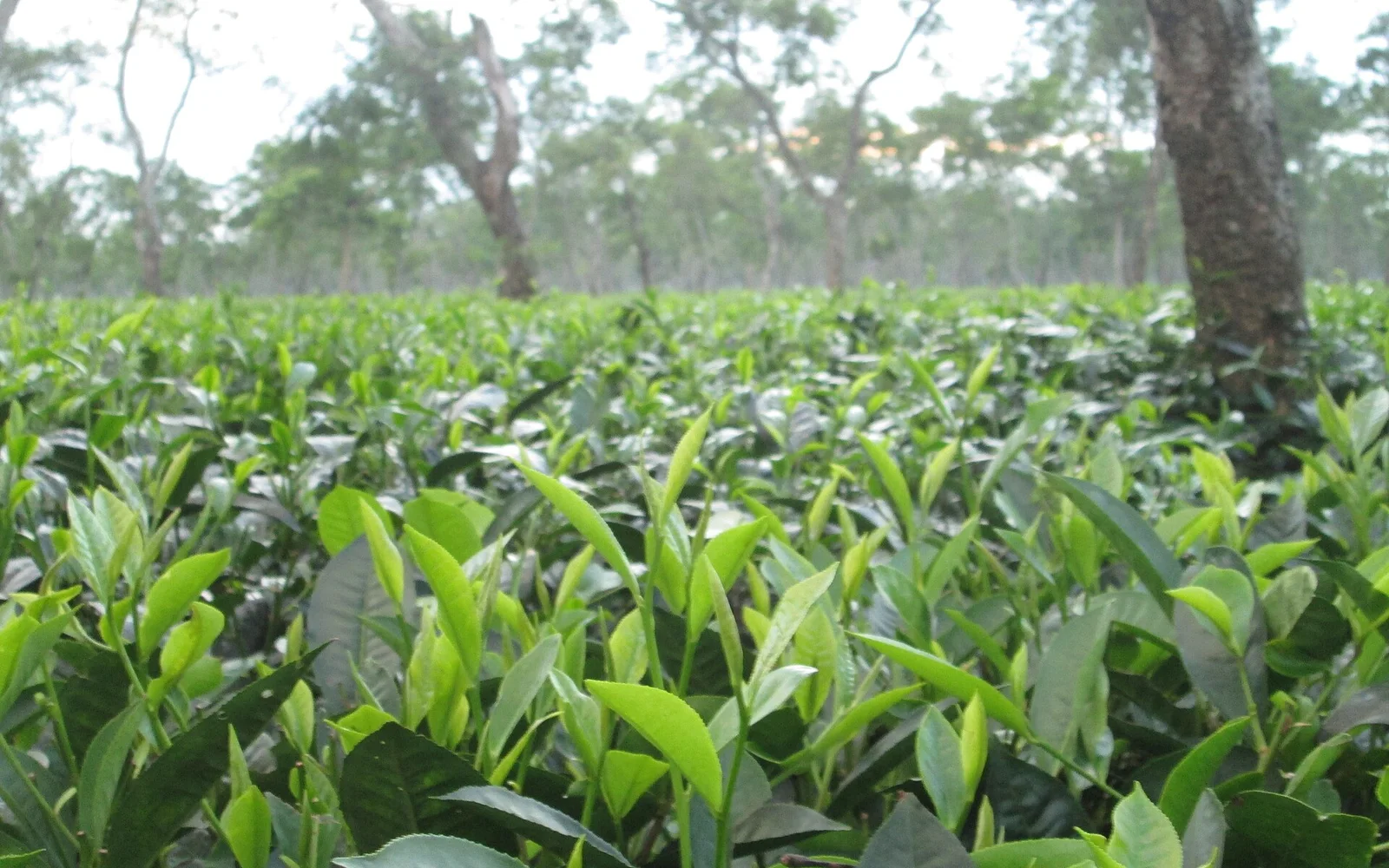
Fly into Dibrugarh in the monsoon and the land below is green in every direction, low, flat and wet, with the Brahmaputra spreading across the valley in braided channels. The tea plantations are laid out in neat rows under tall shade trees, mile after mile, edged by paddy fields and villages.
This valley is one of the few places in the world with a tea plant of its own. The Assam variety of the tea plant grows naturally in its warm, humid lowlands, and the heavy rain and heat of the summer give its leaf a strength that tea from the hills does not have. Assam tea is strong, malty and dark, the kind that stands up to milk. The summer pluck, known as the second flush and prized for its golden-tipped leaves, sells at auction for some of the highest prices in the tea world. Assam grows around half of India’s tea, and you have very probably drunk some of it, perhaps in a hotel breakfast tea in London, Dubai or Tokyo.
The women who pluck it
Much of the tea harvested in Assam is plucked by women. Women move along the rows from early morning with baskets on their backs, picking the top two leaves and a bud, paid a daily wage tied to how much they pick. At the time of writing, the daily wage of a female plantation worker stood at around ₹250.
And for much of the last century and a half, a woman on the plantations who became pregnant has faced high risks in childbirth.
This piece is about her, and about a project that taught me a great deal about what it takes to reach her, USAID’s Saksham, on which I worked. I have tried to write it as a public health practitioner would, with the history, the evidence and the work, rather than as a tragedy. The women of the tea plantations are not victims in a story. They are citizens for whom services and paperwork have not always been easy to reach, and that is a problem with solutions.
How the gardens began
Tea was found growing wild in Assam in the 1820s, and within two decades commercial plantations were being cleared from the forest. They needed labour on a scale the region could not supply. From the middle of the nineteenth century, recruiters brought hundreds of thousands of people to the plantations, mostly Adivasi and other communities from the Chota Nagpur plateau and the surrounding regions of what are now Jharkhand, Odisha, Chhattisgarh and West Bengal. Many came on contracts that bound them to an estate for years, and many did not survive the journey or the first years. These were colonial-era arrangements, very different from the legal framework that exists today.
A century and a half later
Their descendants are still there. Today they are known as tea garden communities, and are also officially referred to as tea tribes. They make up a large share of Assam’s population. Over five or six generations, they have built their own culture, languages and festivals, an identity that blends where they came from with where they now live.
The law around them has changed too. The Plantations Labour Act, 1951 established obligations for plantations to provide medical facilities for workers and their families, along with housing and other amenities. Since November 2025, these obligations sit under the Occupational Safety, Health and Working Conditions Code, 2020, which replaced the Act. In Assam, larger estates run their own tea garden hospital inside the plantation boundary. The availability and quality of these services vary, which is why coordination between estate facilities and the public health system matters. For many families in the labour lines, that hospital is the nearest source of care, and it is part of the health system in practice even when it sits outside the government’s own network.
Much has also stayed the same. Many families still live inside the plantations and depend on the estate for housing, water and rations. For some families, the boundaries of the estates, language, literacy and documents can still make the wider health system harder to reach.
What daily life asks of a woman
For families that depend on plantation wages, pregnancy can bring real financial pressure. A woman who stops plucking stops earning, so many women keep working through pregnancy, in the heat and the rain, bending for hours, often well into the last weeks.
Several studies point to the risks they face.
- High blood pressure. Researchers at the ICMR’s Regional Medical Research Centre in Dibrugarh reported a high prevalence of hypertension (60.8%) among the tea plantation workers they studied in Assam. This is not a current figure for all workers, nor a measure of high blood pressure in pregnancy. The researchers identified extra salt eaten as a side dish as a risk factor, and found that the salted tea drunk at work contains about 8–10 grams of salt per litre. In pregnancy, high blood pressure can lead to pre-eclampsia and eclampsia, which are among the leading causes of maternal death.
- Anaemia. A retrospective study of the 48 maternal deaths recorded over one year at Assam Medical College, a referral hospital in Dibrugarh, found that two-thirds (66.7%) of the women who died were from the tea garden community. Anaemia was the most frequently recorded cause (29.1%), followed by eclampsia (23.0%). These figures describe one hospital, not all maternal deaths in Assam.
- Distance and water. Some gardens are far from a hospital that can manage an obstetric emergency, and monsoon floods can cut roads for days at a time.
- Late care and paperwork. Some women register their pregnancies late, and some find it hard to complete forms or produce the documents that schemes and bank accounts require.
Maternal health
Together, these factors can raise the risk of poor maternal health outcomes. In India’s Sample Registration System, Assam’s maternal mortality ratio was 167 per 100,000 live births in 2019–21, against 93 for India as a whole. That was the picture when this work was under way, and the reason it focused where it did. In the bulletin for 2021–23, it was 110, against 88 for India, and later estimates suggest further improvement. Assam’s estimate carries considerable statistical uncertainty, and the figures say nothing directly about the tea garden population.
Within Assam, the burden has been heaviest in Upper Assam, where most of the tea plantations are. A 2017 audit by the Comptroller and Auditor General of India reported that maternal mortality in Upper Assam, where much of the tea garden population lives, was 404, compared with 301 for the state as a whole, for the period it examined. In the six blocks covering tea garden areas that it checked, 38 per cent of maternal deaths were from the tea garden population. These are historical findings, but they show the gap documented at the time.
The state government has long recognised the particular situation of women on the plantations. Under the Wage Compensation Scheme, launched on 1 October 2018, the National Health Mission, Assam provides “a cash benefit of Rupees 15,000” to each eligible pregnant woman of the tea garden areas, in four instalments, to “provide better health and nutrition to the Pregnant Women of the Tea Garden Areas.” It is designed to ease the financial pressure that keeps many women working through pregnancy. But like any scheme, its effect depends on reaching the women it was designed for.
What we did, level by level
Saksham was a four-year (2021–25) maternal, newborn and child health project funded by USAID and led by PATH, with Jhpiego, Piramal Swasthya and Deloitte as partners. When US foreign assistance was paused for review in early 2025, Saksham was among the projects that continued, recognised as life-saving work. It was a privilege to be part of it. It worked in vulnerable districts of Assam, Chhattisgarh and Odisha, and one of its three objectives focused specifically on partnerships with tea garden hospitals in Assam. What I came to admire most about it was that it did not pick a single fix. It worked at several levels of the health system at once, because the problems of the plantations exist at several levels.
In the community
The work started with the people closest to the women. Saksham formed core groups of frontline workers, ASHAs, ASHA supervisors and ANMs, many of them women from the same communities. It was one of these core groups that identified why some eligible women were not receiving the wage compensation benefit. The scheme’s intended benefit was clear, but forms, documents and bank linkages could stand in the way.
They designed a campaign called MAAdol. With the district programme management unit and a multi-stakeholder forum, frontline workers, bank staff and health staff went to the women, helped them complete forms, sorted out documents and bank accounts, and pushed applications through. In Golaghat district, the National Health Mission’s own posts describe MAAdol as a drive “to make Aadhar enrollment and opening of BankAccount for PregnantWomen of TeaGarden”, run jointly by NHM Golaghat and Saksham (November 2022). A later drive on another tea plantation combined Aadhaar and bank account opening with counselling on the wage compensation scheme, nutrition and family planning (November 2023). According to PATH, the campaign extended the scheme’s reach to more than 5,000 beneficiaries and led to the disbursement of about ₹92 lakh.
The approach spread to other districts. In Lakhimpur, the Saksham team and NHM held an orientation for officials from the labour department, Aadhaar, India Post Payments Bank and health supervisors, covering MAAdol alongside facility assessment, hospital committees and nutrition gardens (December 2024). That list of participants says a great deal about the work. Getting a scheme to a pregnant woman on a tea plantation needed health, labour, identity and banking officials in the same room.
Saksham also worked to strengthen the Village Health, Sanitation and Nutrition Committees, community platforms that exist in every village and can benefit from renewed support. In model committees across four intervention blocks, members prepared individual birth-preparedness plans for pregnant women and monitored them. On one tea plantation in Jorhat, the committee ran an online opinion poll so that everyone in the community could vote on which local issues to tackle first. Another committee, having identified lack of transport as a barrier, arranged an additional vehicle to take pregnant women from the plantation to the nearest health facility. At the same time, Saksham strengthened the supportive supervision of ASHAs, and its Saarthi platform digitally linked women registered in the community to their nearest health facility, so that high-risk pregnancies could be identified, referred and followed up.
In facilities
For many women on the plantations, the tea garden hospital is the closest source of care. Saksham worked with the hospital management committees of tea garden hospitals run under public-private partnership in Dibrugarh, Golaghat, Jorhat and Sivasagar districts. It mapped the hospitals, reviewed the committees, and helped reconstitute them and hold regular meetings. The resulting decisions were practical and visible. Labour rooms were renovated, suction machines and an autoclave were bought, a defunct newborn radiant warmer was brought back into use, and biomedical waste pits were built. Saksham also worked with tea garden hospitals on structured self-assessment of their quality of care.
In public facilities, Saksham supported mentoring and skills practice for providers, including obstetric drills and skills labs in medical colleges.
In the district
Health on a tea plantation involves the estate management, the garden hospital, workers’ representatives, the health department, the labour department and the district administration. Responsibilities are shared across several institutions, which makes coordination essential. Saksham’s Sangathan model set up multi-stakeholder forums that brought them together regularly to identify and resolve issues specific to the plantations, problems that none of them could solve alone. Saksham also strengthened district task forces for maternal and child health, supported facilities towards national quality certification, and provided dashboards for district review. Mobile medical units serving the tea garden areas received technical support too.
These examples describe the implementation work and service improvements in Saksham’s intervention areas. Their contribution to longer-term maternal and newborn health outcomes would need to be assessed separately.
What I carry from it
I learned more on Saksham than on almost anything else I have worked on, and much of it was not technical. I learned that the people closest to a problem usually understand it best, and that the most useful thing a project can do is give them room and support to act. I learned that a good government scheme and a woman who needs it can be separated by a single form, and that closing that gap is real public health work. And I learned that a health system is not one institution but many, such as an estate hospital, a district office, a village committee and a bank branch, and that progress often comes from simply getting them into the same room.
The cup
None of this is a reason to stop drinking Assam tea. The plantations are where these families live and work, and the industry is their livelihood. It is a reason to remember, when the cup is poured, the women whose work makes Assam tea possible, and to recognise that safe pregnancy and childbirth take sustained effort from health systems, communities, employers and policymakers.
Views are my own. Project results refer to Saksham intervention areas and are taken from published PATH and Saksham material.
Sources
- Office of the Registrar General, India. Special Bulletin on Maternal Mortality in India 2019–21 (May 2025) and 2021–23 (September 2025). Sample Registration System. censusindia.gov.in
- Comptroller and Auditor General of India. Report No. 4 of 2017: Impact of National Rural Health Mission on Reproductive and Child Health in Assam
- National Health Mission, Assam. Wage Compensation Scheme for pregnant women of tea garden areas
- Borah P.K. et al. An information, education and communication module to reduce dietary salt intake and blood pressure among tea garden workers of Assam. Indian Heart Journal 2018
- Hazarika L., Phukan P., Sharma A., Das N.K. Maternal mortality at a tertiary care teaching hospital in Dibrugarh district, Assam: a retrospective study. Int J Community Med Public Health 2017;4(9)
- PATH. Advancing maternal, newborn, and child health in tea plantation and tribal communities in India (2023)
- Saksham MNCH Aavishkar Challenge: A compendium of transformative solutions (PATH / USAID)
- The Plantations Labour Act, 1951
- Tea Board of India